India stock market review, August 2026: Foreign investors return, IT stocks rebound and mid-caps keep winning
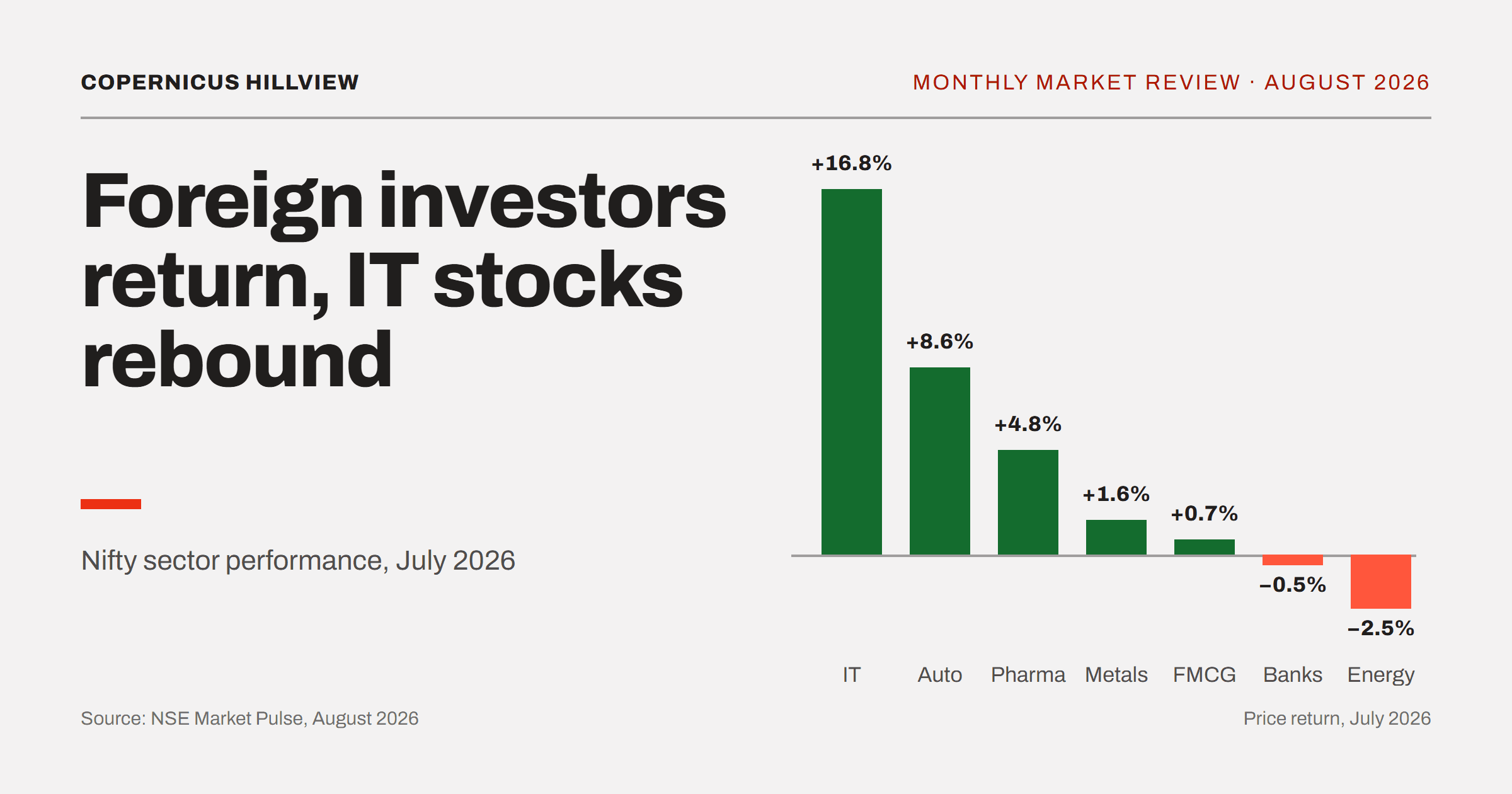
Foreign investors pulled a record US$29 billion out of Indian stocks in the first half of 2026. In July, they came back.
That shift, along with IT's strongest month in six years, defined India's markets last month. Here's what happened, which sectors are leading, and what investors should keep an eye on.
- The Nifty 50 rose 2.2% in July, its second straight monthly gain, as foreign investors turned buyers again.
- IT stocks jumped 16.8%, but the sector is still down about 19% this year.
- Pharma, metals and autos are the strongest sectors over the past year.
- Indians now own more of the stock market than foreign investors, and they are steadily moving into mid- and small-caps.
- Valuations are no longer cheap, so choosing the right stocks matters more than ever.
What moved Indian markets in July 2026?
Around the world, investors sold AI and semiconductor stocks after a strong run. South Korea's market fell 22% in a single month. Money moved towards markets and sectors with more reasonable valuations, and India was one of the winners.
Foreign Portfolio Investors (FPIs), the overseas funds that buy Indian shares, invested about US$2.1 billion in July and another US$2.2 billion in early August. Meanwhile, domestic institutions such as mutual funds and insurance companies kept buying for the 36th month in a row.
The economic backdrop is stable, but there are risks:
- The RBI expects India's economy to grow 6.7% this year.
- Inflation is at 4.4%, above the RBI's 4% target.
- Crude oil jumped about 24% to around US$90 a barrel on Middle East tensions.
- The monsoon is running 13% below normal, which could affect food prices.
Sector scorecard: winners and laggards
| Sector | July 2026 | Last 12 Months |
|---|---|---|
| IT | +16.8% | −13.0% |
| Auto | +8.6% | +21.5% |
| Pharma | +4.8% | +16.5% |
| Metals | +1.6% | +37.0% |
| Energy | −2.5% | +10.3% |
| Banks | −0.5% | +2.3% |
| FMCG | +0.7% | −12.0% |
Source: NSE Market Pulse, August 2026 (price returns as of July 31, 2026)
5 sectors with strong momentum
1. Pharma: the steady compounder. Pharma is India's best-performing sector this year, up about 17%. It is also a growing export story, which gives it support beyond the domestic economy.
2. Metals: riding the AI and green energy boom. Metals are up 37% over the past year. Copper and nickel demand is rising with AI data centres, electric vehicles and renewable energy.
3. Autos and electric mobility. Auto stocks gained 21.5% over the year, and the EV and new-age automotive theme is up about 12.5%.
4. Defence and manufacturing. The defence index has compounded at over 46% a year for three years, helped by rising government spending on capital projects.
5. Capital markets. More Indians are investing than ever before. NSE now has 13.4 crore unique investors, and monthly SIP contributions are close to a record ₹32,000 crore. Exchanges, brokers and asset managers benefit directly from this trend.
2 sectors to watch closely
IT: turnaround or just a bounce? IT's 17% jump in July was its best month in six years, but the sector is still down about 19% in 2026. The bigger question is AI: it could help Indian IT firms move into higher-value work, but it also threatens routine outsourcing jobs. The next few quarterly results will show which way this goes.
Banks: same sector, different stories. Both mutual funds and foreign investors favour financial stocks. Yet HDFC Bank and Axis Bank were among the biggest drags on the Nifty in July, while ICICI Bank and SBI performed well. The sector looks healthy, but individual banks are moving in very different directions.
Where to be cautious
FMCG and consumer staples are down about 12% over the past year, and both domestic and foreign funds hold less of these stocks than their weight in the index. Cement, tourism and railway PSU stocks have also fallen sharply.
The big shift: Indians now own more of India
This may be the most important long-term trend in the report.
- Foreign investors own just 15.1% of NSE-listed companies, the lowest in over 17 years.
- Domestic mutual funds own a record 11.6%.
- Individual Indians, directly and through mutual funds, own a record 19.3%.
Money is also moving beyond the biggest companies. Institutional investment in Nifty 50 stocks has fallen to a record low of 56%. Small-cap funds saw record inflows in July, while large-cap funds had their first outflow since December 2023.
The long-term numbers explain why: over the past five years, mid-cap stocks have grown about 17% a year, almost double the 9% delivered by the Nifty 50.
Why it matters: with foreign ownership at a 17-year low, even a partial return of foreign money could give Indian markets a meaningful boost.
Are Indian stocks expensive right now?
The Nifty 50 trades at about 19.5 times expected earnings, roughly 15% above its long-term average but below the September 2024 peak of 22 times.
Compared with other emerging markets, India now trades at a 108% premium, close to its all-time high of 110%.
In simple terms: Indian stocks aren't expensive by their own history, but they are priced for strong earnings. That makes careful stock selection more important than buying the whole market.
What to watch in the coming month
- Crude oil prices and developments in the Middle East
- Foreign investor flows: will the buying continue?
- IT company earnings: will they confirm the rebound?
- Monsoon progress and its impact on food inflation
Frequently asked questions
Which sector performed best in India in 2026 so far?
Pharma leads with a gain of about 17% from January to July 2026, followed by metals at about 14%.
Why did IT stocks rise in July 2026?
Global investors moved money out of crowded AI and chip stocks in Korea, Taiwan and the US. Combined with resilient earnings, this made Indian IT stocks attractive again after a long decline.
Are foreign investors buying Indian stocks again?
Yes. After record selling of US$29 billion in the first half of 2026, FPIs invested about US$2.1 billion in July and US$2.2 billion in early August.
Are mid-cap stocks better than large-caps?
Over the past five years, mid-caps have delivered about 17% a year versus 9% for the Nifty 50. However, mid-caps are more volatile and can fall harder in corrections.
Source: NSE Market Pulse, August 2026 (Vol. 8, Issue 8), National Stock Exchange of India Ltd. Figures as of July 31, 2026 unless stated otherwise.
This report is for information only and is not an offer or solicitation to buy or sell any security; views and estimates are as of the date of publication and may change without notice. Investments in securities market are subject to market risks; read all the related documents carefully before investing.