Cupid share price surge: how a ₹3 stock became ₹357 — financials, peers and valuation explained
The Cupid share price surge is one of the most extreme re-ratings in Indian markets: Cupid Ltd (NSE: CUPID, BSE: 530843) closed at ₹357 on 08 Oct 2026, roughly 110 times the split- and bonus-adjusted ₹3.25 the new promoters paid in their December 2023 open offer. The stock is up about 730% in one year and its market value, near ₹47,950 crore, now exceeds Gillette India and P&G Hygiene combined.
In this report we unpack what drove the rally, how revenue, margins and cash flows have actually moved, how Cupid stacks up against FMCG and global condom peers, and what growth today's price already assumes.
- ₹357 close on 08 Oct 2026, a fresh record; up ~240% so far in calendar 2026 and ~32x from the April 2025 low of about ₹11 (all figures adjusted for the 2024 split/bonus and the March 2026 4:1 bonus).
- Q1 FY27 (Apr–Jun 2026): revenue ₹154.7 crore (+159% YoY), PAT ₹44.2 crore (+194%), EBITDA margin ~39%.
- FY27 guidance raised three times since May 2026, from ₹600 crore revenue / ₹180 crore profit (May 2026) to ₹800 crore+ / ₹250 crore+ (30 Sep 2026); Q2 FY27 revenue is guided above ₹200 crore.
- Valuation: ~349x trailing earnings, ~192x FY27 guided profit and ~106x trailing sales, versus 18–60x earnings and 2–8x sales for listed personal-care peers.
- The weak spot is cash: FY26 operating cash flow of ₹46 crore covered only ~43% of reported profit, with a cash conversion cycle of about 300 days.
Why is the Cupid share price surging?
The Cupid share price surge rests on three things happening at once: a step-change in earnings, repeated guidance upgrades, and a widening investor base. Profit roughly tripled in Q1 FY27, management has lifted its FY27 outlook three times since May, and index inclusions have brought the stock in front of far more buyers.
Earnings acceleration. Revenue from operations nearly doubled to ₹358 crore in FY26 (Apr 2025–Mar 2026) and net profit rose about 165% to ₹108 crore, beating the company's own FY26 guidance of ₹335 crore / ₹100 crore. Q1 FY27 then delivered another leg up, helped by a roughly 10% price increase on the export portfolio.
Guidance momentum. Each upgrade has acted as a fresh catalyst. The latest, on 30 September 2026, put FY27 at ₹800 crore+ revenue and ₹250 crore+ profit, citing institutional demand, domestic FMCG expansion and progress at the new Palava plant in Maharashtra.
Market plumbing. The third driver of the Cupid share price surge is access. During the September quarter, Cupid moved into BSE Group 'A' and was added to the Nifty Smallcap 250 (effective 30 Sep 2026) and the FTSE Emerging Markets All Cap index. Its shareholder count rose from about 28,000 in September 2023 to 2.95 lakh by June 2026.
Promoter buying. CMD Aditya Kumar Halwasiya has bought shares in the open market in several tranches through August and September 2026, taking his personal stake to 34.71% (filing dated 28 Sep 2026). The tranches are small relative to equity (0.04–0.10% each), but the signal has clearly mattered to sentiment.
Cupid share price surge in three phases: from turnaround to momentum
The chart below rebases every historical price to today's share count (dividing pre-April 2024 prices by 100 and April 2024–March 2026 prices by 5). Without this adjustment, older headlines quoting ₹2,833 or ₹524 are impossible to compare.
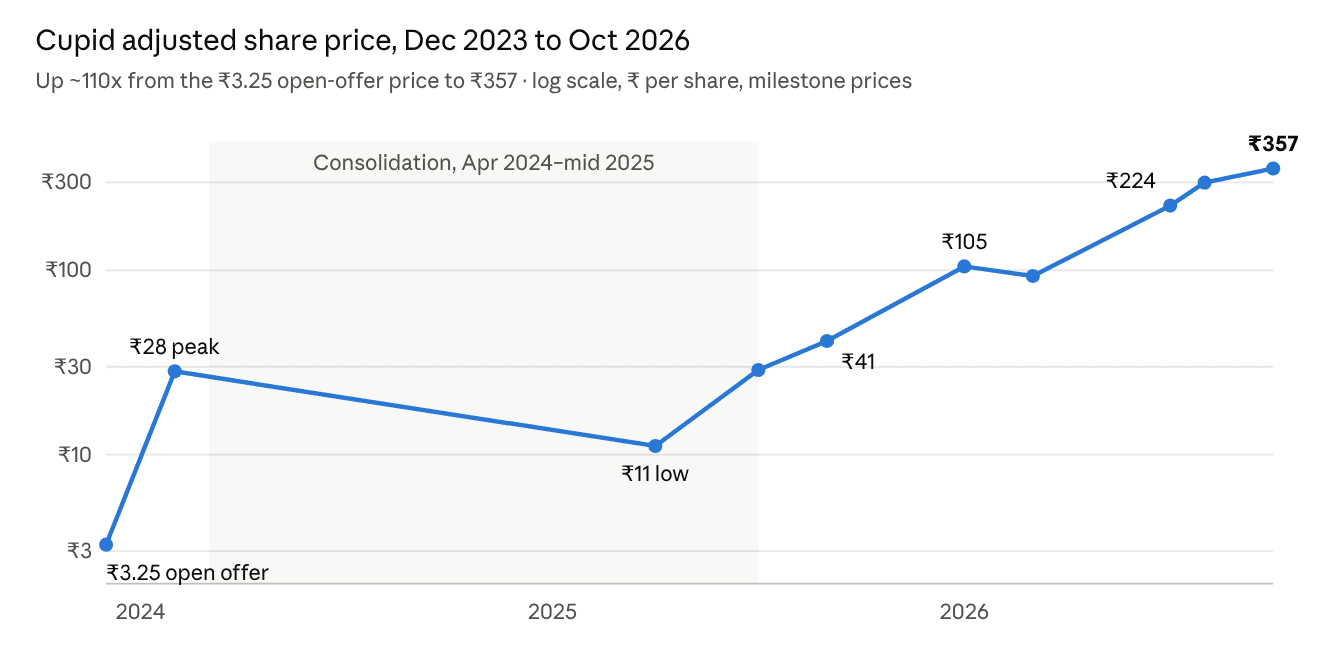
On a log scale, the 2025–26 leg is steeper than the original post-acquisition run, even from a far larger base.
Three distinct phases stand out:
- Ownership change (Oct 2023–Mar 2024). The Universal-Halwasiya group bought 41.84% from founder Omprakash Garg at ₹285 per share (pre-split) and completed a 26% open offer at ₹325. The stock ran up almost 9x into the early-2024 peak.
- Consolidation (Apr 2024–mid 2025). For over a year the stock went nowhere, dipping to about ₹11 (adjusted) in April 2025 before recovering only to its old peak by July 2025.
- Earnings-led momentum (Sep 2025–today). Once quarterly profit started compounding, the stock went near-vertical: ₹41 in September 2025, ₹105 by January 2026, ₹224 by July and ₹357 now.
| Period (to 08 Oct 2026) | Adjusted starting price | Approx. return |
|---|---|---|
| Since Dec 2023 open offer (₹325 pre-split) | ₹3.25 | ~110x |
| Since April 2025 low | ~₹11.2 | ~32x |
| One year (Screener 1-yr CAGR) | — | ~730% |
| Calendar 2026 to date | ~₹105 | ~240% |
| Since Oct 1 2026 (post guidance upgrade) | ₹313.9 | ~14% |
The path has not been smooth. The stock fell about 9% in three sessions after its 14 August high of ₹299, and it has corrected sharply in past phases. It is also under the exchanges' long-term Additional Surveillance Measure (ASM) framework, which raises margin requirements and signals elevated volatility.
What does Cupid Ltd do?
Cupid Ltd is a Nashik-based manufacturer of male and female condoms, water-based lubricants and in-vitro diagnostic (IVD) kits, established in 1993. It is one of India's leading female-condom makers and, historically, a business built on international institutional tenders.
The company now runs two engines:
- International B2B healthcare (~59% of FY26 revenue). Exports were ₹208 crore in FY26 across 125+ countries, supplied to procurement agencies such as PFSCM, WHO/UNFPA programmes and government tenders (including Brazil), plus private-label buyers.
- Consumer healthcare & FMCG (domestic). This contributed about ₹122 crore in FY26, including ₹84 crore from newly launched FMCG products such as perfumes, deodorants and personal-care items. A strategic investment in Baazar Style Retail (Style Baazar) is meant to add about ₹150 crore of revenue in FY27, with management targeting ~₹500 crore a year over the medium term.
Capacity is the near-term bottleneck. The Palava facility, acquired in March 2024, is designed to lift output about 1.5x and is slated for commissioning in Q3 FY27. A Saudi Arabian FMCG plant (funded from internal accruals) and a proposed South African venture extend the footprint further.
How have Cupid's financials trended?
Cupid's financial trend is a story of operating leverage: revenue more than doubled over two years while EBITDA nearly tripled. Trailing-twelve-month revenue reached ₹453 crore with an operating margin of 35%, against ₹183 crore and 23% in FY25.
| Consolidated (₹ crore) | FY21 | FY24 | FY25 | FY26 | TTM (Jun 2026) |
|---|---|---|---|---|---|
| Revenue from operations | 149 | 172 | 183 | 358 | 453 |
| Operating profit (EBITDA) | 41 | 51 | 42 | 119 | 160 |
| Operating margin | 28% | 30% | 23% | 33% | 35% |
| Other income | 0 | 7 | 19 | 32 | 31 |
| Net profit | 29 | 40 | 41 | 108 | 137 |
| Other income as % of PBT | ~1% | 13% | 35% | 23% | 17% |
FY22–FY23 consolidated figures not separately reported.
Quarterly momentum
Quarterly revenue has roughly quadrupled from ₹39 crore in Jun 2024 to ₹155 crore in Jun 2026, and the guided Q2 FY27 figure would take it past ₹200 crore.
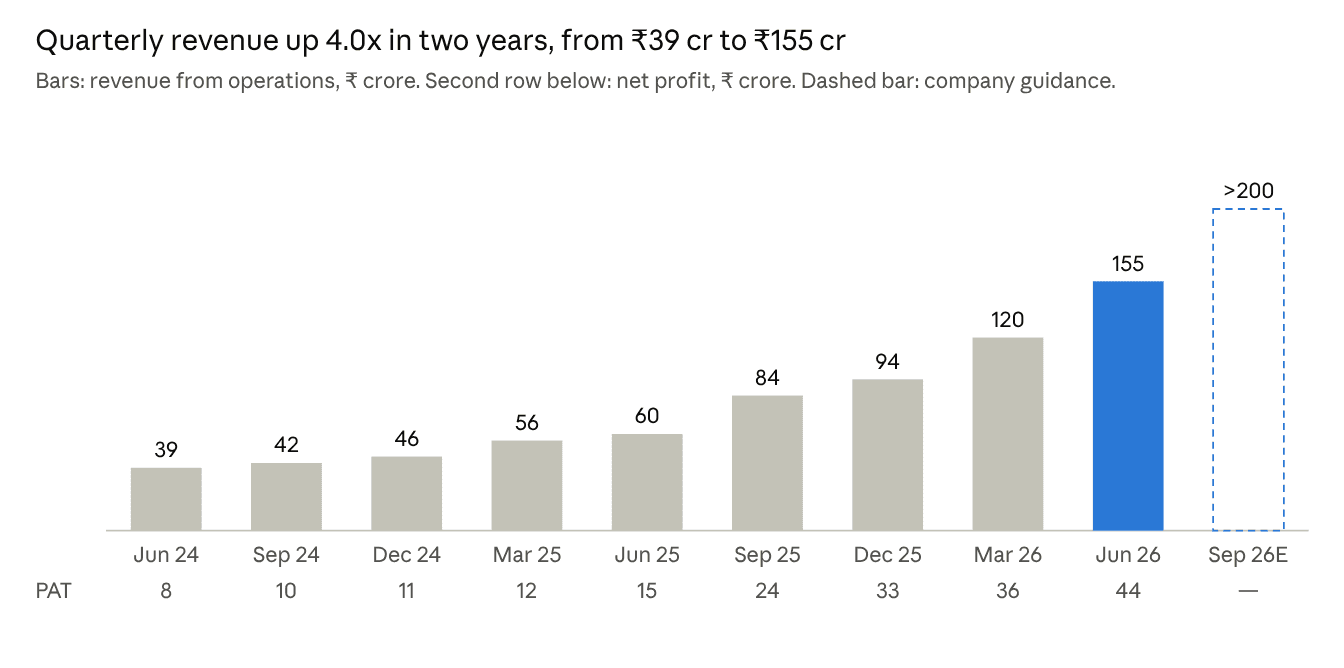
Profit grew faster than revenue because operating margin widened from 17% in Jun 2024 to 39% in Jun 2026.
Margin and earnings quality
Two details sharpen the picture. First, other income was 35% of pre-tax profit in FY25 and 23% in FY26, so part of the earlier profit growth came from treasury income rather than operations. In Q1 FY27 that dropped to about ₹2 crore (~3% of PBT), which means the latest quarter's profit is much more "core".
Second, Q1 FY27 total comprehensive income was only ₹1.7 crore against PAT of ₹44.2 crore. That implies a roughly ₹42 crore loss booked through other comprehensive income, most likely a fair-value movement on investments. Investors should read the notes to the Q2 results to see which holdings drove it.
Cash flow and balance sheet: the weak spot
Reported profits have not yet turned into matching cash. Operating cash flow was ₹46 crore in FY26 against net profit of ₹108 crore, and it was negative (–₹11 crore) in FY25.
| Working-capital & cash metrics | FY24 | FY25 | FY26 |
|---|---|---|---|
| Cash from operations (₹ cr) | 8 | –11 | 46 |
| Free cash flow (₹ cr) | –17 | –31 | 21 |
| Debtor days | 102 | 134 | 103 |
| Inventory days | 184 | 450 | 350 |
| Cash conversion cycle (days) | 285 | 570 | 301 |
| Borrowings (₹ cr) | 12 | 19 | 56 |
Inventory days are calculated on cost of materials and can overstate for tender-driven businesses.
Some of this is structural: tender businesses hold raw latex and finished stock ahead of large shipments, and institutional buyers pay slowly. Still, a 300-day cash cycle plus planned capex (Palava, Saudi Arabia) and investments (Style Baazar, GII Healthcare) means growth will consume cash. Net worth was about ₹451 crore at March 2026, and the company pays no dividend.
Cupid vs peers: how does the valuation compare?
The Cupid share price surge has pushed the stock far beyond its sector. On every standard multiple, Cupid trades far above Indian personal-care companies and global condom makers. At about ₹47,950 crore, its market value exceeds Emami, Honasa Consumer and Jyothy Labs combined (₹38,370 crore), even though those three generate about 21 times Cupid's revenue.
| Company (NSE) | Market cap (₹ cr) | TTM revenue (₹ cr) | TTM PAT (₹ cr) | P/E (x) | OPM | ROE | 1-yr return |
|---|---|---|---|---|---|---|---|
| Cupid (CUPID) | 47,950 | 453 | 137 | 349 | 35% | 27.6% | +730% |
| Gillette India (GILLETTE) | 23,681 | 3,176 | 668 | 35.4 | 30% | 66.5% | –23% |
| P&G Hygiene (PGHH) | 21,940 | 4,245 | 791 | 27.8 | 25% | 115% | –53% |
| Emami (EMAMILTD) | 16,481 | 3,915 | 750 | 21.8 | 25% | 26.2% | –32% |
| Honasa Consumer (HONASA) | 15,250 | 2,553 | 249 | 60.4 | 12% | 15.7% | +65% |
| Jyothy Labs (JYOTHYLAB)* | 6,639 | 2,847 | 370 | 18.1 | 18% | 19.0% | –42% |
Prices of 05–08 Oct 2026. *Jyothy revenue/PAT are FY25.
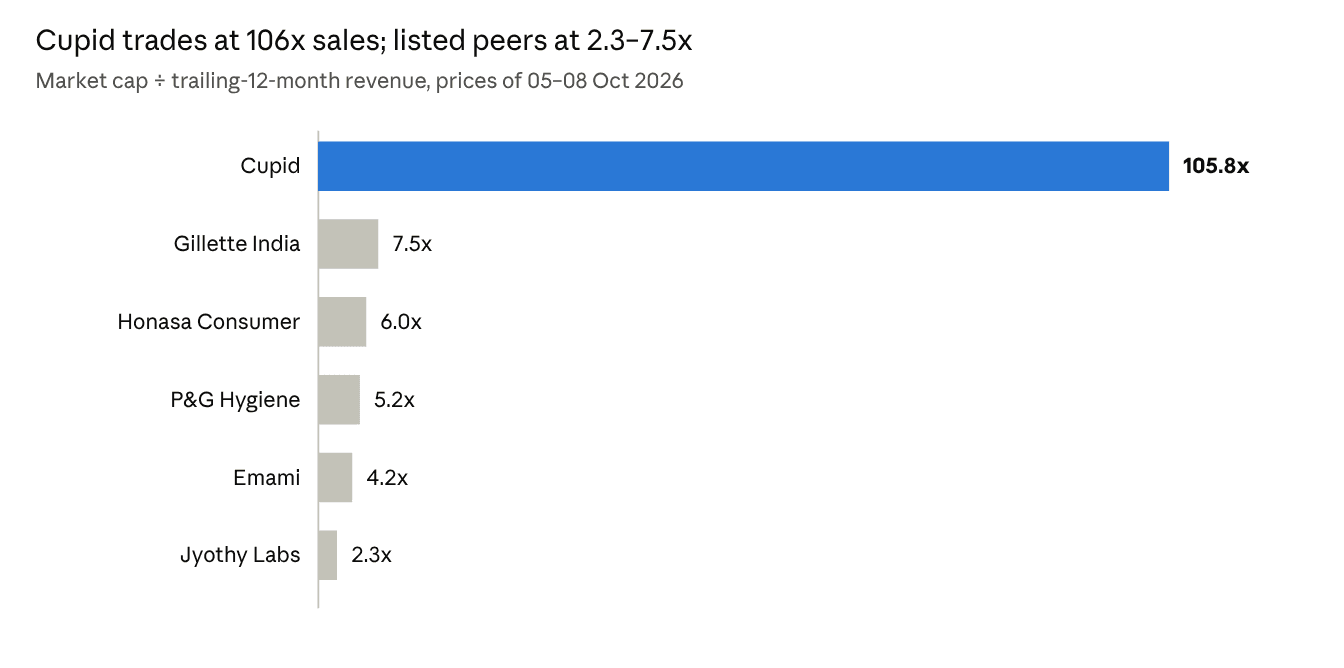
Even Honasa Consumer, the fastest-growing peer with a 60x P/E, trades at about 6x sales.
What the peer gap tells us
Cupid's margins and growth are genuinely superior. Its 35% operating margin beats every peer in the table, and its 122% TTM revenue growth compares with low single digits at Emami, Jyothy and P&G Hygiene. Some premium is justified.
But the premium is extreme in scale. Cupid is valued at about 2x Gillette India, a company with seven times the revenue, a 66% ROE and near-100% dividend payouts. Peers are priced for steady compounding; Cupid is priced for hyper-growth that must last for years.
The global benchmark is sobering. Malaysia's Karex Bhd, the world's largest condom maker by volume (capacity of roughly 4–5 billion pieces a year), reported FY26 (year to June 2026) revenue of RM462 million (about ₹1,093 crore) and net profit of just RM0.3 million (about ₹70 lakh), and trades at a market value of roughly RM0.5–0.6 billion (about ₹1,100–1,400 crore). Karex blamed weaker institutional tender demand after cuts in humanitarian aid funding. Cupid has grown strongly against that same backdrop, which points to share gains and pricing power, but also shows how cyclical tender economics can be.
What growth is priced into Cupid shares?
After the Cupid share price surge to ₹357, the market is pricing in roughly a decade of compounding packed into five years. A simple reverse-valuation shows the scale of what must go right.
We ask: what FY31 profit would justify today's market value if an investor wants a 12% annual return and the stock ends FY31 on a "mature growth" P/E? Today's ₹47,950 crore compounded at 12% for five years equals about ₹84,500 crore.
| Exit P/E in FY31 | Required FY31 net profit | Implied profit CAGR from FY27 guidance (₹250 cr) | Implied FY31 revenue at 30% net margin |
|---|---|---|---|
| 50x | ~₹1,690 cr | ~61% a year | ~₹5,600 cr |
| 35x | ~₹2,410 cr | ~76% a year | ~₹8,000 cr |
| 25x | ~₹3,380 cr | ~92% a year | ~₹11,300 cr |
Copernicus Hillview estimates; illustrative only, not a forecast or price target.
For context, management's own medium-term aspiration is ₹1,500 crore revenue by FY29. Even at a 30% net margin, that is about ₹450 crore of profit, which still puts today's price at roughly 107x FY29 aspirational earnings. And ₹5,600–11,300 crore of FY31 revenue would make Cupid a mid-sized FMCG company in its own right; the five Indian peers above currently generate ₹16,736 crore between them.
None of this means the price must fall. Momentum stocks can stay expensive for long periods, and guidance has been beaten repeatedly. But it does mean the margin of safety is thin, and any slowdown in quarterly growth could hit the multiple hard.
What are the key risks for Cupid investors?
The biggest threat to the Cupid share price surge is a growth slowdown. The main risks are valuation, cash conversion, dependence on institutional tenders and execution on a fast-widening set of projects.
- Valuation compression. At ~350x trailing earnings, even a strong but slower quarter could trigger a sharp de-rating.
- Tender concentration. A large share of exports goes to donor-funded programmes; the aid cuts that hurt Karex could eventually reach Cupid's order book.
- Cash and working capital. A ~300-day cash cycle and rising borrowings mean growth needs funding.
- Diversification risk. Perfumes, deodorants and a retail-linked FMCG push are crowded, low-moat categories very different from WHO-grade condom manufacturing.
- Investment and OCI volatility. Large investments (a planned ₹331.5 crore in Baazar Style Retail, with ₹82.9 crore deployed by May 2026) can swing comprehensive income, as Q1 FY27 showed.
- Currency and raw material. Export margins benefited from a weak rupee and a price hike; latex prices and a stronger rupee would cut the other way.
- Governance and surveillance. The company settled a SEBI proceeding on disclosure-related matters in 2026, per media reports, and the stock remains under ASM. Institutional ownership is still small (FII 4.2%, DII 0.3% at June 2026), so retail flows dominate price action.
What should investors watch next?
Whether the Cupid share price surge can be sustained now depends on delivery. The next three months bring the first hard tests of the upgraded outlook. These are the markers we will track:
- Q2 FY27 results (Oct–Nov 2026): does revenue clear ₹200 crore, and does margin hold near 39%? To hit ₹800 crore for FY27, H2 needs about ₹445 crore, or ~₹220 crore a quarter.
- Operating cash flow and receivables in the half-yearly balance sheet; a narrowing gap between profit and cash would materially de-risk the story.
- Palava commissioning (guided Q3 FY27) and early output data.
- Order-book disclosure for institutional tenders, especially Brazil and UN agencies.
- Style Baazar revenue contribution versus the ₹150 crore FY27 target.
- Shareholding changes: whether FIIs and mutual funds keep building positions after the index inclusions.
Frequently asked questions
Why is the Cupid share price going up?
The Cupid share price surge has happened because profits are growing at triple-digit rates and management keeps raising guidance. Q1 FY27 PAT nearly tripled to ₹44.2 crore, FY27 guidance moved to ₹800 crore+ revenue and ₹250 crore+ profit, and index inclusions plus promoter buying added fresh demand.
What does Cupid Ltd make?
Cupid Ltd makes male and female condoms, water-based lubricants and IVD diagnostic kits, mainly for international health agencies and government tenders. It is also building a domestic FMCG business in perfumes, deodorants and personal care, supported by a retail tie-up with Style Baazar.
Is Cupid share overvalued compared with peers?
On standard multiples, Cupid is far more expensive than peers: about 349x trailing earnings and 106x sales, versus 18–60x earnings and 2–8x sales for Gillette India, P&G Hygiene, Emami, Honasa and Jyothy Labs. Faster growth and higher margins explain part, but not all, of that gap.
What is Cupid's FY27 revenue and profit guidance?
As of 30 September 2026, Cupid guides for FY27 revenue of over ₹800 crore and net profit of over ₹250 crore, with Q2 FY27 revenue expected above ₹200 crore. Guidance started at ₹600 crore / ₹180 crore in May 2026 and has been raised three times since.
Has Cupid issued bonus shares or split its stock?
Yes. In April 2024 Cupid split each ₹10 share into ten ₹1 shares and issued a 1:1 bonus. In March 2026 it issued a further 4:1 bonus. Together, one pre-2024 share equals 100 shares today, so old prices must be divided by 100 to compare.
Who is the promoter of Cupid Ltd?
Cupid is controlled by the Universal-Halwasiya group, which bought out founder Omprakash Garg in 2023. CMD Aditya Kumar Halwasiya held 34.71% personally after his 28 September 2026 purchase, and the promoter group held about 46–47% overall.
Conclusion
The Cupid share price surge reflects a real transformation: a niche condom exporter has become a high-margin, fast-growing healthcare and FMCG business, with profits tripling and guidance repeatedly raised. The price, however, already discounts years of near-flawless execution, while cash conversion lags reported profit. For investors, the next two quarters of cash flow and Palava delivery matter more than the next guidance headline. For how we apply the same lens to other momentum stories, read our Indo SMC Ltd stock analysis.
Related research: HFCL share price surge
This report is for information only and is not an offer or solicitation to buy or sell any security; views and estimates are as of the date of publication and may change without notice. Investments in securities market are subject to market risks; read all the related documents carefully before investing.