Jio Platforms IPO 2026: financials, valuation and key risks explained
Jio Platforms Ltd made ₹30,049 crore profit in FY26 on ₹1,46,885 crore revenue. Here is what the Jio IPO 2026 offer document shows about India's digital market, growth, profitability, valuation and risk — in seven minutes.
Status (07 Oct 2026): SEBI cleared the IPO on 28 Aug 2026. Price band, lot size and dates are not yet announced.
- Fresh issue only: up to 27 crore new shares; ₹27,500 crore goes to repay debt.
- Steady growth: FY24–FY26 CAGR: revenue 15.8%, EBITDA 17.8%, profit 18.4%. EBITDA margin rose to 51.9% in FY26.
- Cash turnaround: cash left after capex rose from ₹1,449 crore to ₹42,071 crore.
- The catch: return on capital fell to 10.8%, so valuation is the key question.
Jio IPO details at a glance
| Item | Detail |
|---|---|
| Issue type | 100% fresh issue; no offer for sale |
| Shares offered | Up to 27 crore (about 2.9% of the company) |
| Use of money | ₹27,500 crore to repay Reliance Jio Infocomm debt; rest for general purposes |
| Promoter stake | Reliance Industries 66.4% before IPO, about 64.5% after |
| Other big holders | Meta 10.0%, Google 7.7%, PIF, KKR, Vista, Silver Lake and others |
| Special quota | Eligible Reliance Industries shareholders and employees |
| Price band, lot, dates | To be announced |
Why India's digital growth matters for the Jio IPO
India's digital economy is projected to grow from ₹49.6 trillion to ₹125.8 trillion (US$1.4 trillion) by FY2031 — and Jio carries about 60% of the country's wireless data. All figures in this part come from the offer document's Industry Overview.
India's economic backdrop
| Indicator | Figure |
|---|---|
| Nominal GDP | ₹345.5 trillion (US$3.8 trillion) in FY2026 → ₹555.6 trillion (US$6.2 trillion) by FY2031, 9.97% CAGR |
| Real GDP growth | 6.6% estimated for FY2027 (RBI) |
| Median household disposable income | About ₹0.7 million (FY2026) → about ₹1.1 million (FY2031), 9.19% CAGR |
| Median age | About 28 years |
| Retail inflation | About 2.1% in FY2026, a six-year low |
| Fiscal deficit | About 9.5% (FY2021) → about 4.4% (FY2026) |
| Foreign direct investment | Over US$70 billion of gross inflows in each of the last five years |
India's digital economy today
- Third-largest digital economy in the world, at about 14% of gross value added; expected to reach about 22% by FY2031.
- Second-largest mobile data market: 71.6 exabytes of wireless data in Q3 FY2026, behind only China.
- Heavy users: 25.7 GB of mobile data per user per month, above the USA and China (about 16–18 GB).
- Mass adoption: about 556 million UPI users, about 601 million OTT viewers, and 434 million rural internet users (Dec 2025).
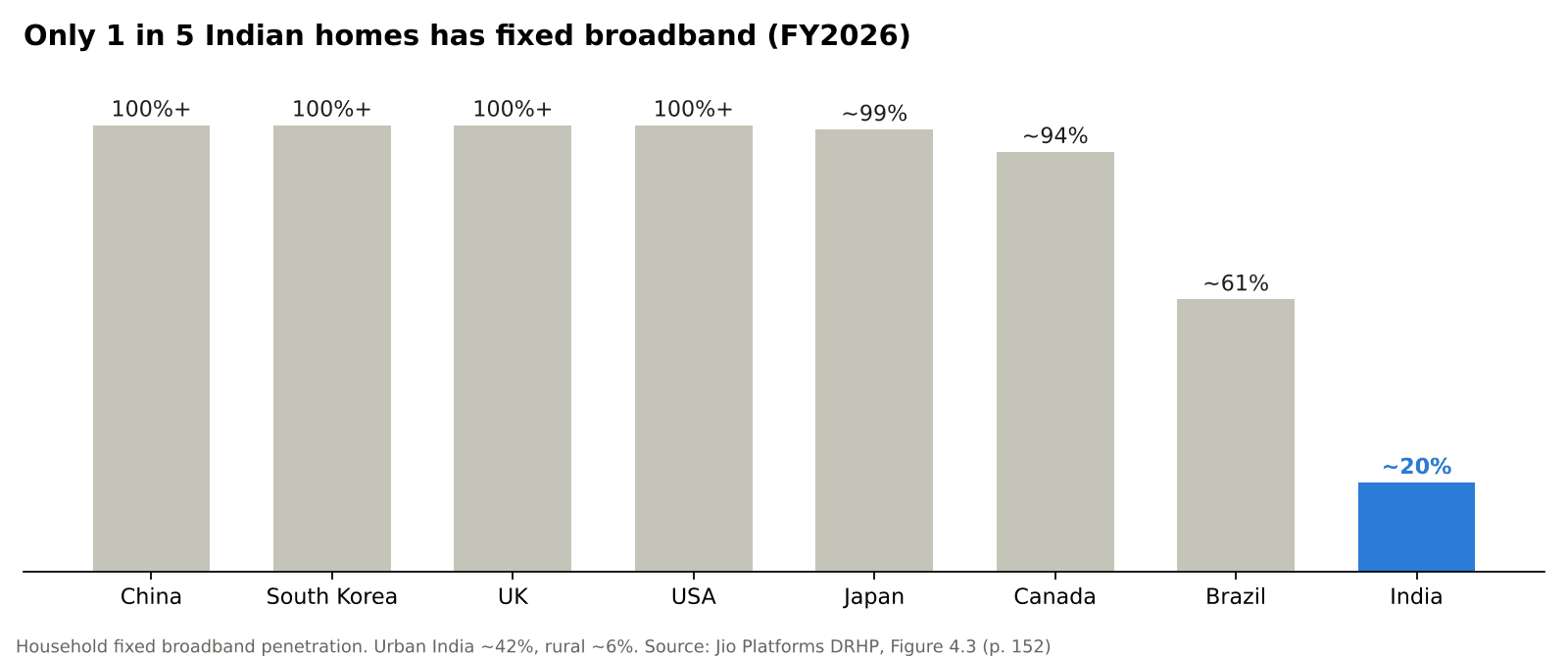
- Still room to grow: only 68.5% of Indians use mobile broadband, and only about 20% of homes have fixed broadband.
What is the market size and future growth?
India's mobile connectivity market — Jio's core — is projected to grow from ₹2.7 trillion in FY2026 to ₹5.2 trillion by FY2031, while home broadband nearly triples.
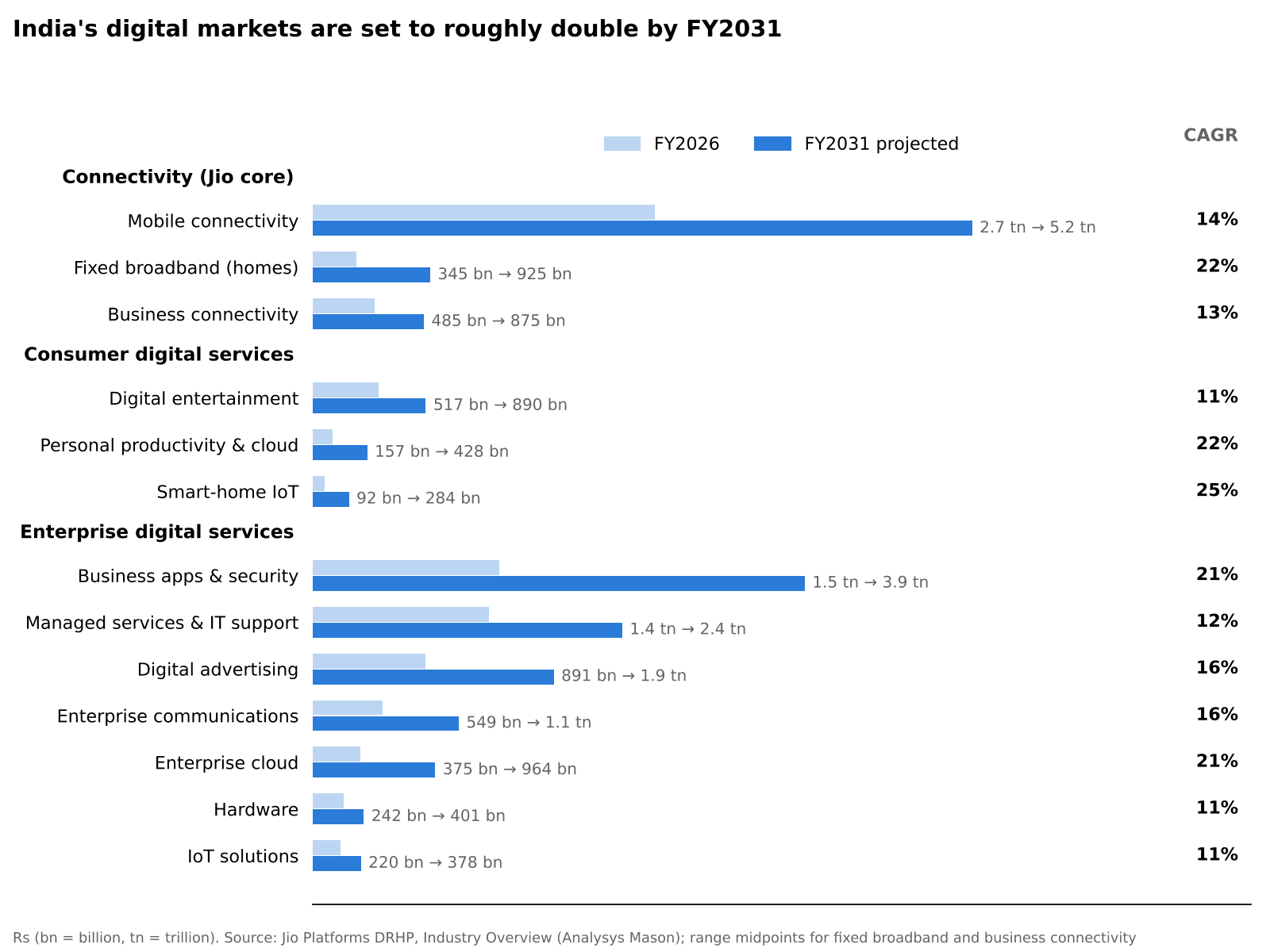
What drives it: mobile broadband users rise from 1,002 million to 1,339 million, and industry mobile broadband ARPU from ₹199.8 to ₹326.4 a month. Fixed broadband homes grow from 63.6 million to 150.4 million (18.8% a year), taking household penetration from about 20% to about 46%.
Our read: that ARPU forecast implies about 10% growth a year. Jio's own ARPU grew only 3.3% in Q1 FY27 — so the industry forecast assumes tariff hikes that have not happened yet.
How does India compare globally?
India uses more mobile data than the USA or China but pays far less for it, and lags badly in home broadband and digital services — that gap is the growth runway.
| Benchmark | India | China | USA |
|---|---|---|---|
| Mobile data per user (GB/month) | 25.7 | about 16–18 | about 16–18 |
| Price per GB of mobile data (₹) | 7.9 | 17.5 | 239.8 |
| Internet users (% of population) | 53% | 84% | 83% |
| E-commerce users (% of population) | 18% | 69% | 82% |
| OTT video users (% of population) | 41% | 71% | 88% |
| Homes owning a computer | under 10% | about 50% | over 95% |
Data usage and price are for Q3 FY2026; user shares are FY2026.
- Mobile ARPU is low for India's income level. The DRHP's global chart shows India's mobile broadband ARPU below the line implied by disposable income, even after the projected rise to FY2031.
- Business spending is low too. Enterprise digital services are 1.47% of GDP in India (₹4.68 trillion), against 3–5% in the UK, Canada, Japan and South Korea; under 3% of small businesses use them.
- Where Jio stands: 49.95% of wireless broadband users, 42.6% of fixed broadband and 77.5% of 5G/radio fixed-wireless homes (March 2026), with the largest spectrum holding at 26,800.8 MHz.
How does Jio Platforms make money?
Jio Platforms is, economically, a telecom operator with a growing digital layer. Its subsidiary Reliance Jio Infocomm Ltd (RJIL) served 524.4 million customers at 31 Mar 2026. The DRHP reports a single operating segment, so investors cannot see standalone profitability for cloud, AI or smart-home products.
- Consumers: mobile and fixed broadband (JioFiber, AirFiber), entertainment, cloud gaming, cloud PC, storage, smart home and AI assistants.
- Businesses: enterprise broadband, leased lines, cloud, IoT, private 5G, managed Wi-Fi, security and AI enterprise suites.
Reuters has reported that telecom typically contributes 75–80% of revenue. Treat the “AI and platforms” narrative as optionality, not as the core earnings base you are paying for today.
What do the operating KPIs say?
| KPI | FY24 | FY25 | FY26 | Q1 FY27 |
|---|---|---|---|---|
| Customers (million) | 481.8 | 488.2 | 524.4 | 533.3 |
| Net adds (million) | 42.5 | 6.4 | 36.2 | 8.9 (quarter) |
| ARPU, exit quarter (₹/month) | 181.7 | 206.2 | 214.0 | 215.6 |
| Data per user (GB/month) | 28.7 | 33.6 | 42.3 | 43.7 |
| Monthly churn (%) | 1.52 | 1.81 | 1.67 | about 1.6 |
| Data traffic (billion GB) | 148.5 | 184.5 | 241.4 | +26.9% YoY |
- FY25's ARPU jump was tariff-driven. ARPU rose 13.5% after the July 2024 hike, but subscriber adds collapsed to 6.4 million and churn rose to 1.81%.
- FY26 growth was volume-driven. With no tariff action, ARPU grew only 3.8% while net adds recovered to 36.2 million.
- Q1 FY27 confirms the slow-ARPU regime: ₹215.6, up ₹7 YoY with no tariff change. The next tariff hike is the biggest earnings lever.
Home broadband is the fastest-growing line: 28.6 million fixed broadband users at June 2026, with AirFiber driving over 75% of additions.
How fast is Jio growing?
Revenue grew 15.8% a year and profit 18.4% a year between FY24 and FY26.
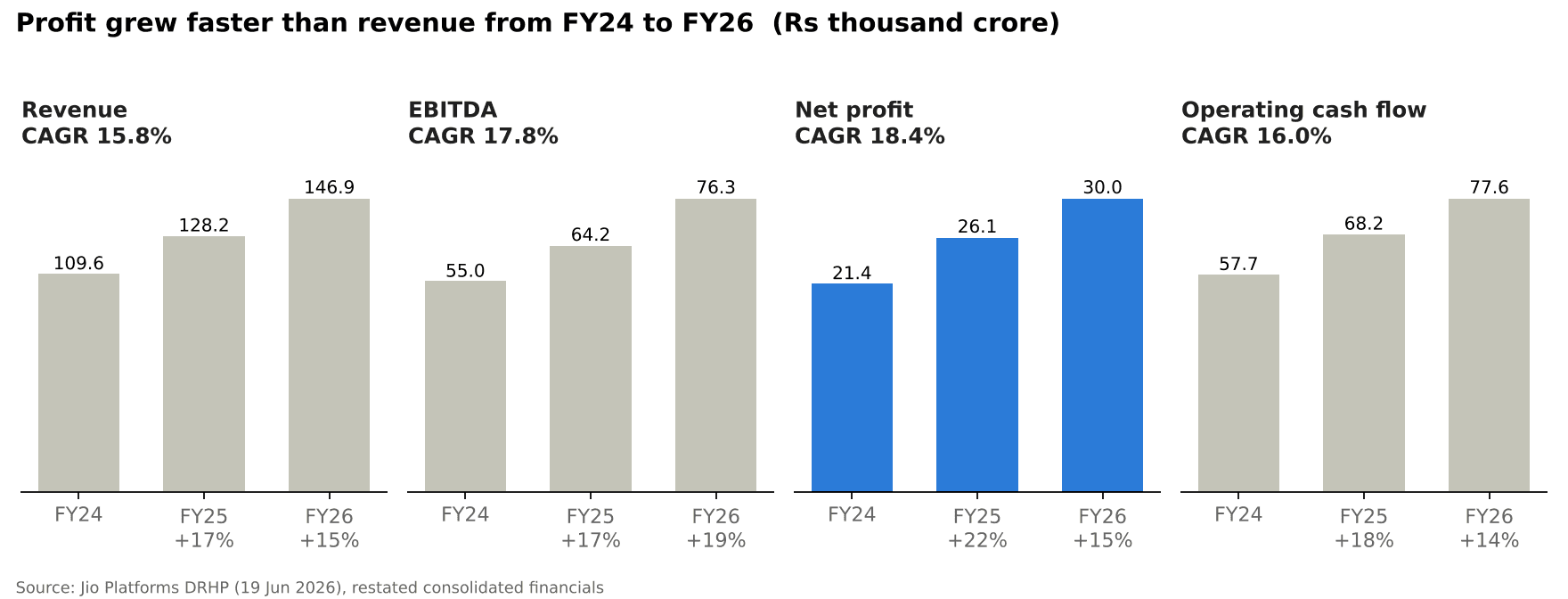
Growth is slowing, though: Q1 FY27 (Apr–Jun 2026) revenue rose 11.8% and profit 9.2%, with no tariff hike in the past year.
Is Jio profitable enough?
Jio earns more than half its revenue as EBITDA (51.9% in FY26), but its return on capital is falling.
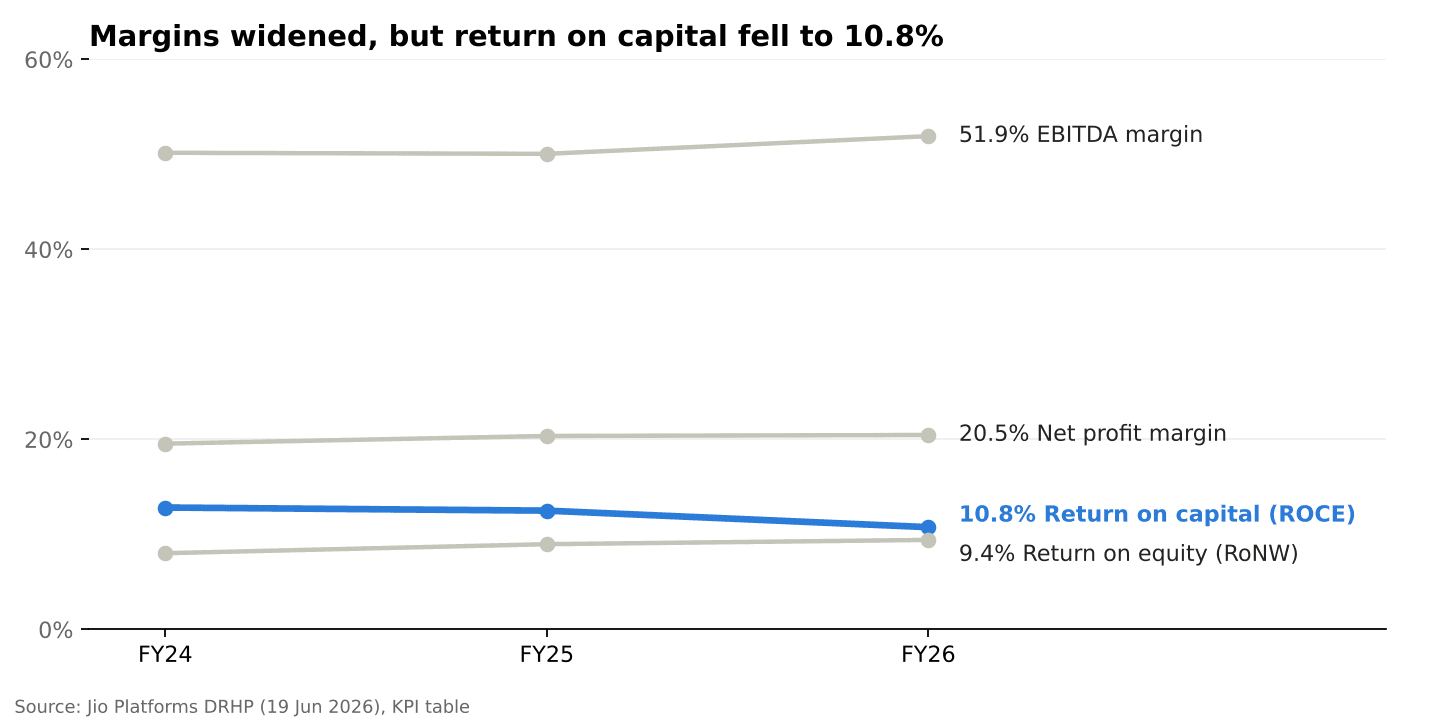
The good news: 5G spending has peaked, so cash left after capex jumped about 29 times in two years.
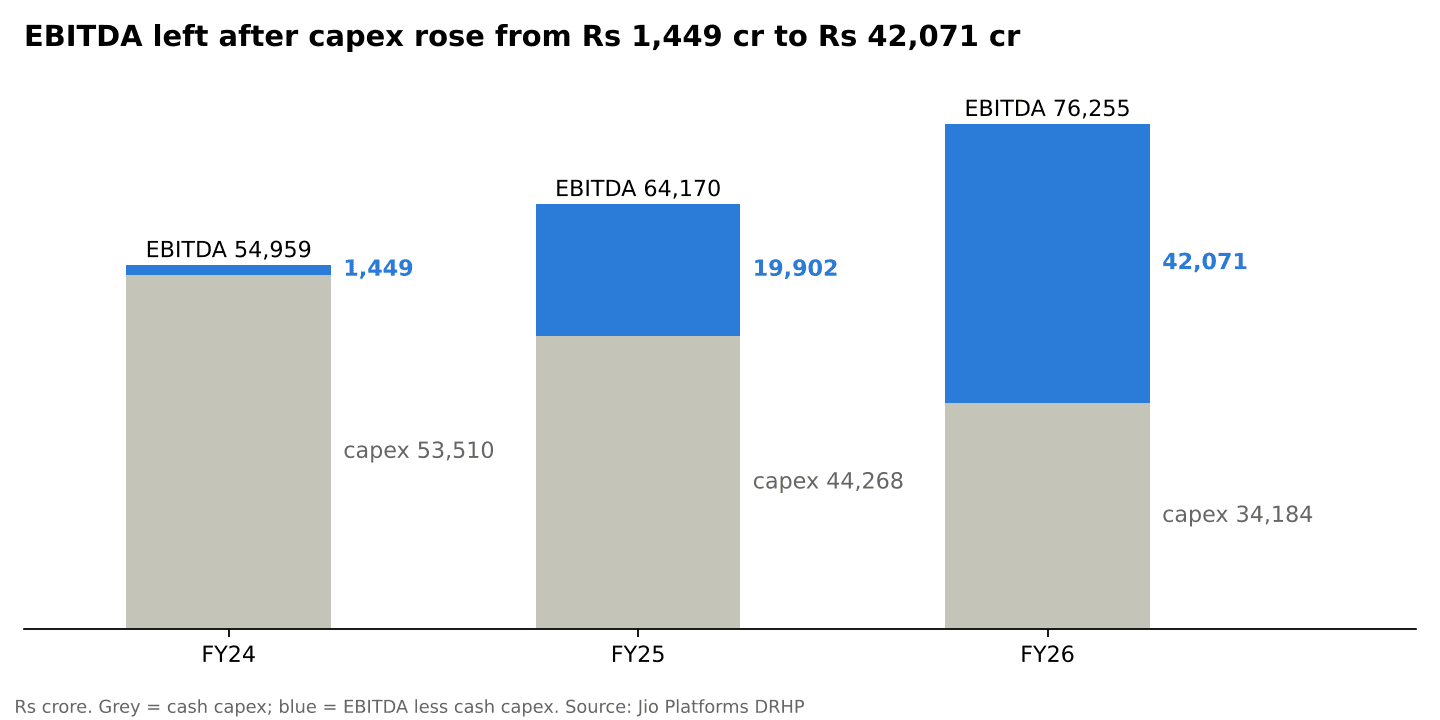
Debt is low: net debt was only 0.36x EBITDA in FY26, and the IPO money will cut it further.
Jio IPO valuation: what does each price mean?
To fund the ₹27,500 crore debt object from 27 crore shares, the issue price must be at least about ₹1,019. Reported ₹35,000–40,000 crore issue sizes imply roughly ₹1,296–1,481 per share and a market cap of ₹11.9–13.6 lakh crore. Bankers' widely reported ₹12.5–17 lakh crore range translates to ₹1,357–1,846 per share.
Valuation sensitivity grid (our calculation)
| Issue price (₹) | Post-issue m-cap (₹ lakh cr) | P/E on FY26 EPS (x) | P/E on Q1 FY27 annualised (x) | P/B post-issue (x) | EV/EBITDA FY26 (x) |
|---|---|---|---|---|---|
| 1,100 | 10.13 | 33.7 | 32.6 | 2.8 | 13.3 |
| 1,300 | 11.97 | 39.8 | 38.6 | 3.2 | 15.6 |
| 1,500 | 13.81 | 46.0 | 44.5 | 3.7 | 17.9 |
| 1,700 | 15.66 | 52.1 | 50.4 | 4.1 | 20.3 |
| 1,850 | 17.04 | 56.7 | 54.9 | 4.4 | 22.0 |
Assumptions: post-issue shares of about 920.9 crore; FY26 PAT ₹30,049 cr (post-issue EPS ₹32.63); Q1 FY27 PAT ₹7,764 cr × 4; post-issue book = FY26 net worth ₹3,34,013 cr + gross proceeds; EV uses FY26 net debt of about ₹27,450 cr less proceeds, and excludes deferred spectrum liabilities. Illustrative prices, not forecasts.
How does Jio compare with Bharti Airtel?
| Metric (Q1 FY27, Apr–Jun 2026) | Jio Platforms | Bharti Airtel |
|---|---|---|
| Mobile ARPU (₹/month) | 215.6 | 264 |
| ARPU growth YoY (%) | 3.3 | 5.6 |
| Revenue growth YoY (%) | 11.8 (operating) | 18.4 (consolidated, incl. Africa) |
| Net profit (₹ crore) | 7,764 | 8,167 |
| Net profit growth YoY (%) | 9.2 | 37.3 |
| Market cap (₹ lakh crore) | 10.1–17.0 (implied range) | 12.29 (4 Aug 2026) |
| P/E on annualised Q1 profit (x) | 32.6–54.9 | about 37.6 (our calculation) |
The valuation question in one line: Jio earns 18% less per user than Airtel and grew profit a quarter as fast in Q1 FY27. At or above Airtel's multiple, you are paying for ARPU catch-up, future tariff hikes, home broadband and AI to show up in earnings.
What are the main risks?
- Slower growth: without a tariff hike, Jio's revenue per user rose only 3.3% in Q1 FY27.
- Spectrum costs: future spectrum auctions can eat into free cash.
- Group dependence: key services come from Reliance group companies, and the “Jio” brand is shared.
- Tax disputes: ₹6,767 crore of GST claims are not provided for in the accounts.
- More shares later: under 3% is floated now, so more share sales are likely in coming years.
5 checks before you apply
- Where does the price band sit in the valuation table above?
- Has any telecom tariff hike been announced?
- Which big funds took the anchor portion?
- Do you qualify for the Reliance shareholder quota?
- Can you hold through a 20–30% fall? Size your bid accordingly.
Ignore grey-market premium (GMP) talk — it is unofficial and unregulated.
FAQs
When will the Jio IPO open?
No date yet. SEBI approved the IPO on 28 Aug 2026; dates and price band will be announced soon.
What is the Jio IPO price band?
Not announced. The debt-repayment plan implies at least about ₹1,019; reported issue sizes suggest ₹1,300–1,480.
Will Reliance shareholders get a quota?
Yes. Eligible Reliance Industries shareholders on the record date get a reserved portion.
Is the Jio IPO a fresh issue or an offer for sale?
Fully a fresh issue. No existing shareholder is selling.
Conclusion
The Jio IPO 2026 brings a large, profitable and now cash-generating business to market. Whether it is worth applying depends on the price band — use the valuation table above and the Bharti Airtel comparison above to compare.
Related research: India stock market review, August 2026 · Indo SMC share analysis
About the author: Copernicus Research is the equity research desk of Copernicus Hillview Investments and Capital Pvt Ltd.
This report is for information only and is not an offer or solicitation to buy or sell any security; views and estimates are as of the date of publication and may change without notice. Investments in securities market are subject to market risks; read all the related documents carefully before investing.